
Astrocartography Guide: How to Read Your Relocation Map
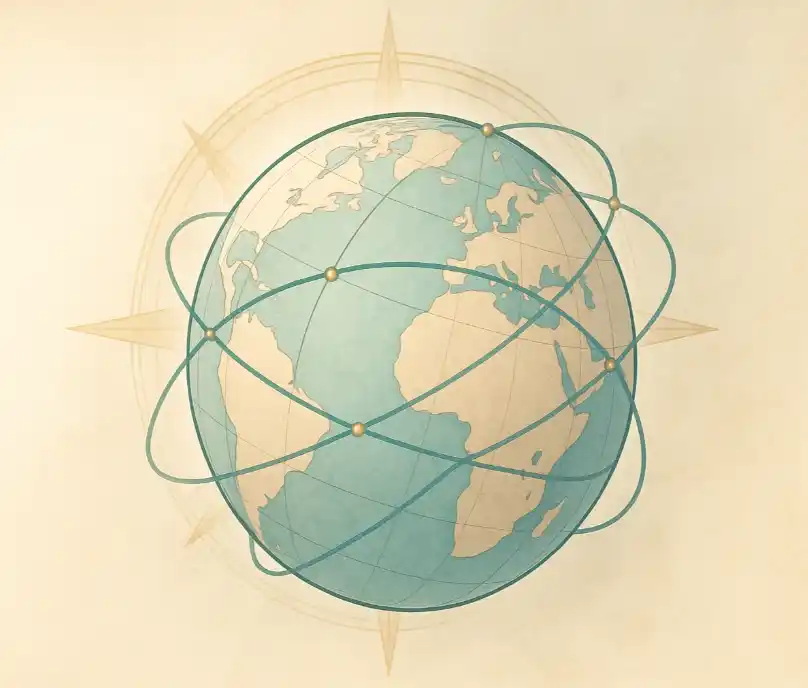
Astrocartography—also called relocation astrology—projects your birth
chart onto a world map. By tracing where each planet touches the Earth’s
angles, you can uncover cities that amplify love, career, creativity, and
more. In the next ten minutes you’ll learn exactly how these lines work and
how to use them to choose your best places to live, work, or travel.
Table of Contents
What Is Astrocartography?
Astrocartography—sometimes called relocation astrology—is the practice of projecting your natal birth chart onto a world map. By calculating where each planet in your chart rises, culminates, sets, and reaches its nadir (ASC, MC, DSC, IC), the technique plots coloured great-circle lines across the globe. Living or travelling close to a line is believed to magnify that planet’s symbolism: a Venus line can heighten love and creativity, while a Saturn line may bring discipline—but also extra responsibility.
The method was formalised by American astrologer Jim Lewis (1941-1995), who trademarked the term “Astro*Carto*Graphy®” and taught thousands of students long before online maps existed. Modern software uses high-precision libraries such as the Swiss Ephemeris, accurate to within an arc-second, so your personalised map can now be rendered in under a second. Layering AI on top translates raw planetary geometry into plain-English guidance aligned with your goals—something the original paper overlays could never do.
In short, astrocartography is a geographical lens on your birth chart. It doesn’t replace traditional astrology; instead it answers the missing question: where on Earth each planetary energy resounds the loudest. With that insight you can choose cities that nurture your career, relationships, or spiritual growth—and sidestep locations that accelerate stress.
Quick History Timeline
- 1970 – Jim Lewis begins researching geographic astrology.
- 1978 – Coins & trademarks the term “Astro*Carto*Graphy®”.
- 1985 – Publishes correspondence course and paper map overlays.
- 1992 – First desktop mapping software released on DOS.
- 1995 – Lewis passes; the A*C*G Foundation keeps teaching.
- 2011 – USPTO trademark expires; term enters public domain.
- 2020s – AI-powered interactive maps arrive on mobile.
How Astrocartography Maps Are Calculated
Every astrocartography line is a projection of the moment a planet touches one of the four angular points of the Earth’s rotation relative to your exact birth time. The calculation unfolds in three steps:
- Ephemeris lookup. High-precision astronomical tables—like the Swiss Ephemeris—provide the ecliptic longitude and latitude for each planet at the millisecond you were born.
- Sidereal time shift. Your birth location is converted to Greenwich Mean Sidereal Time so the planets can be mapped onto the local horizon and meridian.
- Great-circle projection. For every planet, software solves when its position would rise (ASC), culminate (MC), set (DSC), or anti-culminate (IC) at every longitude. The result is four continuous great-circle paths encircling Earth. Where two or more planets share latitude, “paran” intersection points are calculated as hotspots.
Older programs required hours of trigonometry or static wall maps. Modern code can compute all twelve planetary lines in under 50 milliseconds, then feed the coordinates directly into an interactive tile layer like Mapbox GL. This speed is what allows real-time toggles and mobile pinch- zooming—features impossible in the paper era.
Tools You Can Use
| Platform | Speed | Mobile UX | Personalised Narrative | Cost |
|---|---|---|---|---|
| Astro-Seek (web) | Fast | Limited | No | Free (ads) |
| Astro.com “AstroClick” | Medium | Poor | Generic blurbs | Free (account required) |
| Horoscope.ai Map | Instant <1 s | Excellent | AI-tailored | Free preview / $14.99 PDF |
Planetary Lines Explained
Each coloured line on an astrocartography map represents a planet touching one of Earth’s four angles. Living or travelling near a line magnifies that planet’s influence. Below are quick-hit meanings for the twelve most popular planetary lines—all angles (ASC, MC, DSC, IC) behave in this general style, with the exact angle flavour noted in our interactive map.
☀️ Sun Lines
Vitality, leadership, visibility. Near a Sun line you’re pushed onto centre stage—great for building confidence, personal branding, or launching a solo venture. Beware ego burnout: schedule rest so bright spotlight doesn’t overheat your system.
🌙 Moon Lines
Emotional tides run high: family, memories, intuition. A Moon line can feel nurturing for healing and creative flow, yet moody for long-term career grind. Ideal for writers, therapists, and anyone craving comfort food or hometown vibes abroad.
🗣️ Mercury Lines
Buzzing networks, ideas, fast learning. Mercury energises communication jobs, study programs, co-working hubs. Expect busy streets and inboxes; the mind races, sleep may thin. Perfect for digital nomads who thrive on constant conversation and curiosity.
💖 Venus Lines
Love, art, money flow more easily. Venus softens social circles and sweetens aesthetics—think café culture, fashion, beautiful landscapes. Watch over-spending and indulgence. Couples trips or art residencies sparkle on a Venus MC or ASC line.
🔥 Mars Lines
Action, competition, libido. Mars lines add heat: superb for sport, startups, or breaking inertia. Conflict and impatience can spike, so channel energy into workouts & tactical goals. Red flags: accidents rise if anger festers.
📈 Jupiter Lines
Expansion, luck, teaching vibes. Jupiter lines broaden horizons through travel, academia, or scaling a venture. Things grow quickly—including waistlines. Great for grad school, writing a book, or opening new markets.
🪐 Saturn Lines
Structure, discipline, mastery. Saturn may feel heavy but rewards sustained effort: excellent for degrees, apprenticeships, debt payoff. Social life runs lean until obligations are met. Patience is currency here.
⚡ Uranus Lines
Freedom, tech, surprises. Life on a Uranus line rarely follows plans: sudden moves, odd friendships, flash insights. Perfect for inventors and rebels; anxiety-prone travellers might prefer shorter stays.
🌊 Neptune Lines
Dreams, spirituality, fog. Neptune can inspire music, film, meditation retreats—or confusion and escapism if boundaries blur. Ideal for sabbaticals, creative incubation, seaside living. Keep practical anchors.
🌑 Pluto Lines
Transformation, power dynamics, deep research. Pluto lines dismantle old identities so a stronger one emerges; intense for relationships and hidden truths. Choose these lines for therapy, investigative work, or major life reboot.
🪄 Chiron Lines
The wounded healer. Chiron lines expose vulnerabilities but offer profound teaching moments and mentorship paths. Great for counsellors, healers, holistic startups. Embrace imperfection to access wisdom.
⚖️ North Node Lines
Growth edge & karmic learning. North Node lines nudge you into unfamiliar terrain that accelerates life purpose. Rapid connections, fated events. Can feel destabilising until you lean into new roles.
Step-by-Step: Read Your Own Map

① Gather Your Birth Data
Accuracy starts here. Note your exact birth date, city, and clock time down to the minute. Ask a parent or request a birth certificate if needed. Even a ten-minute error can shift lines by up to 150 km, changing which cities fall under a planet’s influence.
② Open the Interactive Map
Launch our free map tool (scroll here). It auto-loads your planetary lines in under a second using Swiss Ephemeris data and the Mapbox vector engine—no downloads or log-ins required.
③ Toggle Planets for Your Goal
Click the toolbar to switch lines on or off: Venus for love & aesthetics, Jupiter for growth & luck, Sun for visibility, Saturn for discipline. Our AI side-panel rewrites the meaning in plain English based on the goal you select (career, relationships, creativity, etc.).
④ Note 3–5 Promising Cities
Zoom and pan to spot where your chosen planet lines intersect major metro areas. Record a shortlist of three to five cities within 100–150 km of the line (living exactly on it isn’t necessary). Use the “Save City” bookmark to build a personal relocation wishlist.
⑤ Validate with Local Transits
A great line can still feel different depending on the current sky transits. Our paid PDF cross-checks today’s planetary positions against your shortlisted cities and flags windows of enhanced opportunity or stress. This extra layer prevents moving to a Jupiter city the week Saturn squares your Sun!
Case Study: Moving to a Sun MC Line
Alex R. was a 32-year-old UX designer living in cloudy Manchester, UK. His astrocartography map showed a Sun Midheaven (MC) line running straight through Lisbon, Portugal. The Sun MC is famous for spotlighting career visibility, leadership, and public recognition—all traits Alex felt were missing from his current job.
After a week-long scouting trip he decided to relocate. Within nine months the results were measurable—and dramatic.
Before
- £48 k salary
- NPS* self-rating 6/10
- 1 conference talk
After 9 Months
- €72 k salary (+38 %)
- NPS self-rating 9/10
- 4 conference talks & podcast guest spots
“Lisbon felt like the sun finally pointed a spotlight on my work. Clients found me instead of the other way around.”
*NPS self-rating: Alex scored his personal happiness on a scale of –100 to +100 before and after relocating.
Common Myths & FAQs
Myth #1: “You Must Live *Exactly* on the Line.”
Planetary influence fades gradually, not abruptly. An orbital “orb” of up to 150 km / 90 mi on either side still counts. Think of the line as the centre of a Wi-Fi hotspot rather than a razor’s edge.
Myth #2: “Bad Lines Are Cursed.”
There are no inherently evil lines. Challenge lines (e.g., Saturn, Pluto) can foster discipline or transformation—valuable energies when approached consciously. Context and timing matter more than simplistic good/bad labels.
Frequently Asked Questions
- Q: Do I need my exact birth time?
A: Yes—within two minutes if possible. Small time errors shift all lines east or west. - Q: What if I don’t know my birth time?
A: Ask relatives, check birth records, or use a rectification astrologer to estimate. - Q: How wide is the orb of influence?
A: About 75–150 km (50–90 mi). The closer you are, the stronger the effect. - Q: Is the map free?
A: Interactive browsing is free; the personalised PDF deep-dive costs $14.99. - Q: How often should I recheck lines?
A: Lines don’t move, but transits do. Review major transits yearly or subscribe to monthly alerts.
Next Steps: Turn Insights into Action
You now understand what astrocartography lines mean and how to read them. The real magic happens when you apply those insights to daily life. Here’s your action checklist:
Small steps—like a weekend trip to your top Venus line—often confirm what the map predicts faster than endless theorising. Pick one action above and schedule it this week while the inspiration is fresh.
Resources & Further Reading
Deepen your relocation-astrology knowledge with the authoritative sources below. Each link opens in a new tab.
- Swiss Ephemeris Library — high-precision planetary data used by most modern calculators.
- Jim Lewis & A*C*G Foundation — official archive of the technique’s founder, including certification info.
- “Methodology of Astrocartography” — peer-reviewed paper dissecting mathematical assumptions.
- Skyscript Cartography Primer — in-depth article on angles, orbs, and parans.
- AI Applications in Geographic Astrology — exploratory study on machine-generated interpretations.
TL;DR Recap
- ✓ Lines = lenses. Each planet amplifies different themes where it touches Earth’s angles.
- ✓ Accuracy matters. Exact birth time shifts lines by hundreds of kilometres.
- ✓ Test, then move. Short trips + transit timing confirm the map’s promise before big leaps.
Found this guide useful? Share it and help fellow explorers find their best place on Earth!